
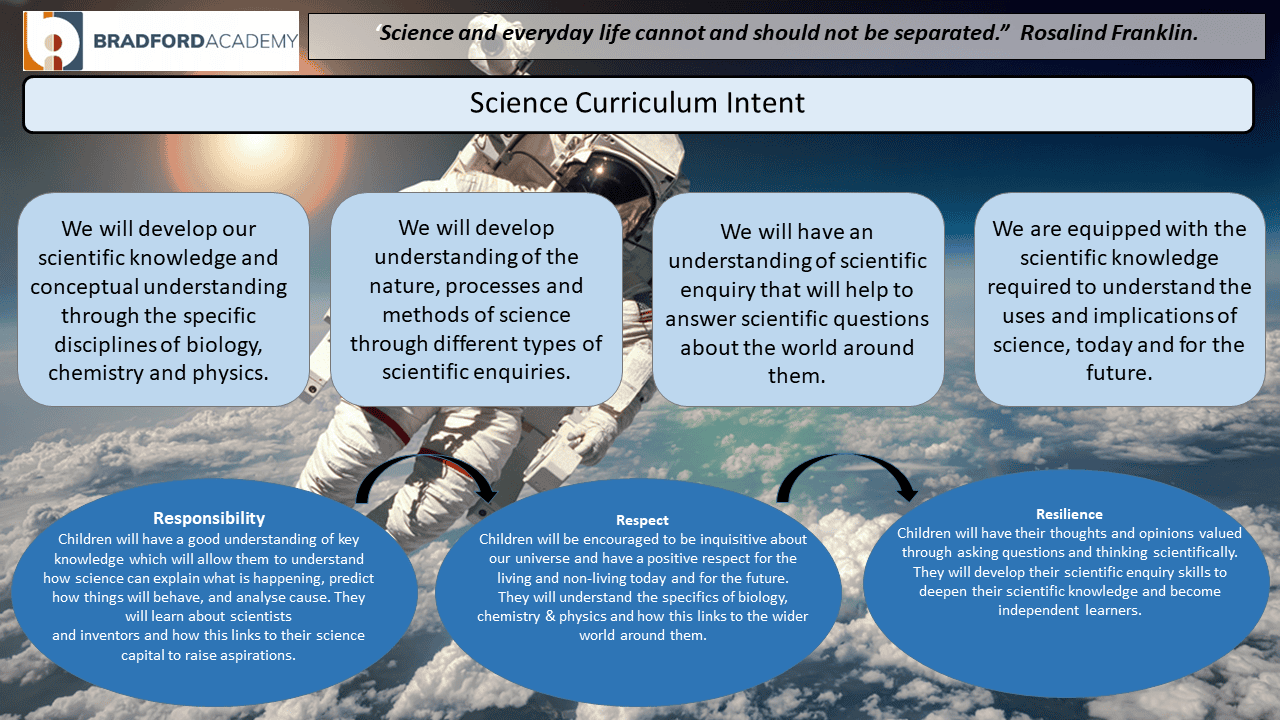
Children will be encouraged to be inquisitive about our universe and have a positive respect for the living and non-living today and for the future. They will understand the specifics of biology, chemistry and physics and how this links to the wider world around them. Children will have their thoughts and opinions valued through asking questions and thinking scientifically. They will be encouraged to recognise the power of explanation and develop a sense of excitement and curiosity about natural phenomena. Children will have a good understanding of key knowledge which will allow them to understand how science can explain what is happening, predict how things will behave, and analyse cause. Children will learn about scientists and inventors and how this links to their science capital to raise aspirations. They will develop their scientific enquiry skills to deepen their scientific knowledge and become independent learners and equip them for an ever-changing world.
Resources
The following websites are free (or have free elements) for children to use to develop their critical thinking skills and love of science:
https://explorify.wellcome.ac.uk/
Curriculum
A high-quality science education provides the foundations for understanding the world through the specific disciplines of biology, chemistry and physics. Science has changed our lives and is vital to the world’s future prosperity, and all pupils should be taught essential aspects of the knowledge, methods, processes and uses of science.
The national curriculum for science aims to ensure that all pupils:
Policy and Assessment
Children are taught specific skills and are assessed against the Science National Curriculum statements at different points of the year. Formative assessment is ongoing and are used to aid the summative assessment and the end of a unit. Feedback is given to parents in the learner’s annual report indicating whether children are ‘working towards’, ‘working at’ or ‘working beyond’ age related expectations.
Resources
The following websites are free (or have free elements) for children to use to develop their critical thinking skills and love of science:
https://explorify.wellcome.ac.uk/
www.bbc.com/teach/terrific-scientific
www.bbc.com/bitesize/subjects/z2pfb9q